
God Hates Divorce
The effort to make marriage permanent


I’ve been writing my book, Not Today, Fascists, and during the process, I’ve been working with journalist — and now good friend — Julia Sonenshein. Julia and I hit it off instantly. She’s back on I’ve Had It Substack with reporting on Christian Nationalism’s designs on your personal life, especially your marriage.
Xx,
Jennifer
God Hates Divorce
Names and some identifying details are changed.
Alli’s kids were with their grandparents that night, and dinner with her best friend seemed like a break from the unrelenting past few months.
Rachel led her into the familiar split-level. The dinner table was set for four and included two women from their women’s group at church. Alli recognized one but they weren’t particularly close. The other woman was older and had a sweet name like Bonnie or Ronnie.
Growing up in a Restorationist sect, Alli had seen how revered older women were for their family-making. “They would be heralded as elders and these wise people who could guide us in the community. I really idolized that,” she tells me over Zoom from her home in the Midwest.
If she thought it was strange that there were two surprise guests, Alli didn’t say anything. She’d had a lifetime of learning the “skills of just going with the flow and coming into someone else’s agenda” — critical tools of survival within her Evangelical world.
They chatted idly about their days. “I wasn’t the tradwife,” Alli tells me, but her denomination tilted toward strict gender roles. Bonnie wore skirts and baked the family’s bread. Alli wore pants and ate McDonald’s. By the time dinner wrapped up, Alli was ready to be home.
“We just thought we could talk for a couple of minutes,” Rachel said, leading them into the living room. A Bible came out, and finally someone named it: Two weeks before that dinner, Alli and her husband, Greg, had separated.
The point of the dinner invitation and unexpected guests suddenly crystalized. They were staging an intervention. Revulsion hit Alli immediately, followed by hot betrayal. Still, she sat with the women for a couple of hours as they made their case.
By then, Alli had tried to overcome her sinful, rebellious nature that made her push back against Greg’s controlling streak. She’d read The Five Love Languages. She’d been to multiple Christian counselors both alone and with Greg. She had long understood that the other side of the passion she’d originally seen in him was an explosive rage. That he could humiliate her at a moment’s notice. She’d called the police after Greg assaulted her in their kitchen in front of her children, desperately telling the operator she just wanted a better marriage. She had truly tried.
They countered with advice about how each of them submitted to their husbands. And when Alli described Greg’s behavior, Bonnie simply told her, “Men are like that. God is working on them in his own time, and he has brought you alongside of him to help soften the hardship of that.” Bonnie might acknowledge the reality and say, “That sounds really bad. I’m sorry he did that to you. You need to pray for him.” The other women nodded.
When Evangelicals consider ending a marriage, “often, support of their church friends completely vanishes. This means that the same people who pledged to be the people they ‘do life with’ are just suddenly gone,” Erica Smith, a sex educator who specializes in purity culture recovery and the author of The Purity Culture Recovery Guide: The Shame-Free Sex Education You Deserve, tells me. Ambushes like the one Alli sat through are common in “small groups” — a loose umbrella term that can include Bible studies, affinity groups like Men’s groups or Mom’s groups — which serve outwardly to foster fellowship and accountability. Another term for this might be “enforcement of norms.”
“Some people go from having a rich community to having no community at all, in an instant, with no one reaching out again,” Smith says.
Religion serves as a particular social incubator of anti-divorce sentiment, whether through explicit interventions like these, rules that make divorce difficult or impossible (such as the Jewish law that a divorce can only be granted by a husband, stranding an estranged wife in a legal limbo and without the ability to move on), or through implicit codes communicated over a lifetime of faith.
“Most [people in Evangelical churches], regardless of gender, were taught that divorce is absolutely never an option. Many of them have parents and family members who have existed in harmful and even abusive marriages because of their religious beliefs, and think that should be an example for everyone,” Erica tells me. “My clients have shared feelings of failure, isolation, humiliation, and of being utterly alone in their experience.”
There is no religion that exacts more control over American life than Evangelical Christianity, and Christian Nationalism, which seeks to curb the entirety of American society in line with a fundamentalist reading of the Bible, is now the mainstream of political power. And the movement is clear about divorce: There should be less of it, and it should be more punitive.
Some people go from having a rich community to having no community at all, in an instant, with no one reaching out again.
The state works in tandem with social pressure to remain married, which isn’t limited to church groups or even religion. My own experience of divorce revealed a surprising strain of social conservatism within my secular world, one that seemed remarkably resonant with these Evangelical churches.
Marriage has always been a tightly controlled institution in America, with states exacting varying levels of regulation of coupling. Sixteen states still had anti-miscegenation laws, which criminalized interracial marriage, until 1967’s landmark Supreme Court case, Loving v. Virginia. Same-sex marriage was not legal in all 50 states until 2015 after Obergefell v. Hodges.
Divorce, too, was a highly regulated enterprise, and was largely considered a failure, if it was considered at all. It has never been easy to come by a divorce, and like marriage, grounds for divorce varied by state. Before the concept of no-fault divorce — or how we largely recognize modern divorce — grounds had been proven, whether a spouse claimed cruelty, abandonment, or something else that met your state’s guidelines. Because some states’ restrictions were so narrow, people seeking to leave their marriages might go to another state with less stringent requirements to be issued their divorce, much like people who must travel for reproductive care or gender affirming care these days.
My home state of California was the first to adopt no-fault divorce in 1969, and today, all 50 states recognize no-fault divorce, meaning that the state will grant anyone a divorce without either party needing to prove the misconduct of their spouse. Critically, neither spouse can simply veto the divorce. No-fault divorce is the legal recognition that anyone is free to leave a marriage for any reason. In other words: Marriage is a choice, not a trap.
No-fault divorce was a remarkable shift in American life — especially for women. The Boston College Law Review notes lowered domestic violence and female suicide rates. No-fault divorce came with economic benefits for women, too. What’s more, it promotes “female autonomy by providing a means for women to unilaterally leave oppressive marriages.”
It’s not surprising, then, that no-fault divorce presents a major threat to the Christian Nationalist project, and their leaders have been vocal about looking for fewer divorces. At a 2021 event at a southern California high school, Vice President JD Vance said that “making it easier for people to shift spouses like they change their underwear” — even if marriages were violent, was “one of the great tricks that I think the sexual revolution pulled on the American populace.”
The Heritage Foundation, which wields tremendous influence over multiple branches of the American government, wrote in its Encouraging Marriage and Discouraging Divorce report: “Today, laws and government policies provide virtually no protection for the institution of marriage.” It’s a remarkably transparent point: The project of the Christian Nationalists is not to protect people. It protects systems of power.
Their recommendations include a series of delaying tactics, making couples jump through hoops like “divorce education,” counseling, and mediation before filing; ending no-fault divorce for couples who have children; making “covenant marriages” a legal option, which lengthens divorce times and requires a series of extremes to be met in order to dissolve a marriage.
The social pressure Alli saw in her church group shows up in political rhetoric — clinging to the idea that the strength of the American, white, heterosexual marriage is the key to national health. It’s much like the purity culture’s belief that the sexual morality of the American teen is tied to the health of the nation — unsurprisingly, the Heritage Foundation’s recommendations for discouraging divorce include abstinence education in high schools.
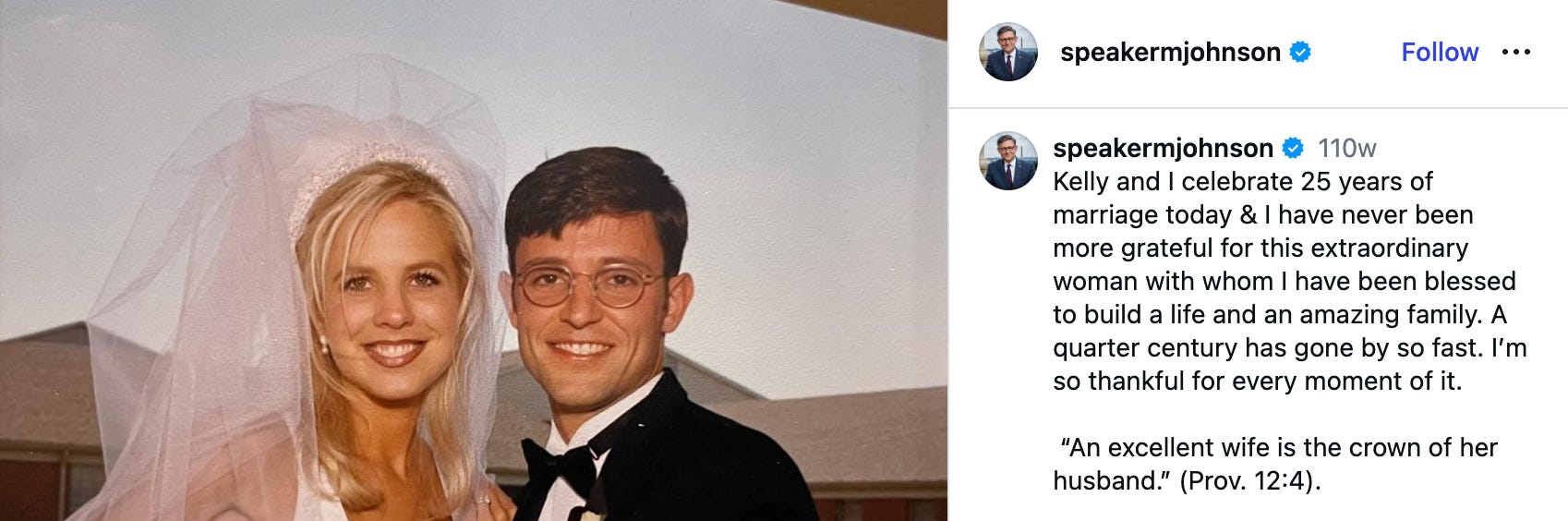
Speaker of the House Mike Johnson, who has one of those convenient marriages, wants to make it harder to get divorced, going so far as to blame in part our “completely amoral society” that causes a young person to go “into their schoolhouse and open fire on their classmates” on no-fault divorce. During his failed US Senate campaign, current Oklahoma state senator Dusty Devers said, “I want to see no-fault divorce come back to at-fault in divorce and even public shaming for those who are at fault in divorce.”
The project of the Christian Nationalists is not to protect people. It protects systems of power.
As we speak, Texas has a bill in committee to weaken no-fault divorce. It’s not the only state — bills like this crop up constantly. These bills get introduced and maybe they end up not passing but they keep trying. There are civil rights now taken for granted in American life, but their strategy is effective. Consider all the raised and failed bills that eventually made it. The right to abortion. The Voting Rights Act. They keep pushing until something breaks.
It’s been just over two decades since Alli and Greg first met. She was just out of the private Christian college in the Bible Belt, working at a European mission of her church, and Greg was eight years older, seemingly settled, confident, and impressive. She’d witnessed his baptism in the river and joked, “Oh, your sins are floating down to Hamburg.”
If there were things that didn’t feel right, like Greg calling her dad and asking permission to court her, Alli had an easy answer when she struggled to submit to his authority: “This is your stupid sinful nature coming back to oppose people. This is what you need in your life. This is what you wanted. This is what God has given you.”
They had their first kiss in September and were engaged in January. Married in May. On their tense and conflict-heavy honeymoon in Italy, Alli remembers saying, “God, I need help because I’m not doing this wife thing right. I’m clearly triggering him.” Back home in Germany, Alli was increasingly isolated, buckling under the language difference and Greg’s absence. They needed to move back to America where there would be support and English-speaking, Christian counselors.
Sunday services. Wednesday services. Bible studies. Small groups. They dove into church life, and Alli joined the worship team, eager for spiritual guidance and support. By then, they had small children and a marriage growing increasingly volatile. She told friends about Greg’s rage, his yelling, pushing her down on the bed, blocking the door when she tried to leave, his absence. “He couldn’t possibly,” was the standard response. Maybe she was overdramatizing, she told herself. Maybe she was being too controlling. The Christian counselors agreed. Alli, after all, had always feared she’d struggle to submit.
There were breaking points. The assault was just one of them. But in that period of separation — where Alli’s best friend had ambushed her with that intervention — Alli saw that something was broken that couldn’t be fixed: “He fundamentally saw me as not as valuable as him.”
That realization in and of itself is reason enough to leave a marriage. But it wouldn’t fly in a fault-based divorce system.
Alli’s experience of being disbelieved by her community dovetails with the impossibility of proving legal grounds in so many cases. It can be nearly impossible to prove abuse or to untangle toxic patterns in a marriage, and explaining the end of a marriage kicks up the same biases that play out in courts along gender, race, or class lines.
It’s undeniable that constraining the ability to freely pursue divorce will cast its heaviest burden on women — at the very least, we know that women initiate almost 70 percent of American divorces. Fault-based systems also require women to finance proving their spouse’s fault, and in a society where more women than men take on domestic, unpaid labor while husbands control the finances, it can be an impossible proposition.
Convincing your community that rocking the boat is worth it feels impossible. Convincing your community that you deserve to be happy feels impossible. Now try convincing the state.
Looking back, it was some kind of blessing that Alli was so deeply done by the time her friends ambushed her, trying to convince her to save her marriage. “If there was any less resilience or grit in me, I would have crumbled in this moment,” facing the women who were supposed to be her support system.
But she thought of her own children and what they were watching play out.
“Do I want my kids to grow up and see our interactions as love?” she asked herself. “And I could do that. I could leave for that. I could stand up to him. I could put my foot down. I could become a divorced woman.”
She made plans to leave, got a burner phone, and opened her own bank account. When she broke the news to her friends, they parroted the same line: “God hates divorce.” She was kicked off the worship team.
To stay, to go, to bind yourself legally to another — pick your poison — these are basic elements of personal agency.
In the past five years, Alli’s children alleged abuse by Greg, who’d had limited visitation in the first place. A judge issued a restraining order, and he is no longer a part of their lives. Within her community, the narrative started to build that she hadn’t ever truly been a Christian in the first place, and so it was easy to dismiss her. Her parents, still devout, no longer speak to her.
Alli left the church and deconstructed her belief system entirely. She is unrecognizable from that person trying everything to stay. Over three hours of Zoom calls, I loved her weirdness, her humor, the look of rebellion unchained. Her life exists paradigmatically differently than anything else she’d experienced, full of contradictions and ecstatic mess. The costs are there, too, but she bears them.
I won’t pretend that I am totally impartial or that my interest in no-fault divorce comes solely from a deep well of empathy. My 20-year partnership ended in divorce. And on the other side of a painful two-year negotiation and creating a new life, what remains for me the biggest gift is the fact that it’s not as definitional as I initially imagined it would be. Counter to everything I’d expected, my marriage and divorce are just things that happened a while ago, like wisdom teeth or singing in the high school choir. And while I won’t downplay the emotional work it took to get there, it’s clear to me that there were massive structural elements that made it possible for the divorce to be a period in my life and not its defining characteristic.
As far as I’m concerned, it’s still too hard to get a divorce. Even without having to prove the reasons for our end, which are nebulous and brutal and ultimately quite mundane, it was still so, so hard. It was punishingly expensive. It was gendered in ways I didn’t anticipate, leaving me feeling remarkably naive.
These days, I genuinely believe more people should get divorced, and I don’t think anyone is particularly entitled to an explanation. Certainly not the state. To stay, to go, to bind yourself legally to another — pick your poison — these are basic elements of personal agency. Nothing could threaten the Christofascist state more than each of us remaining a willing participant in our own lives.

I totally loved reading this piece. As a woman and a senior I have been witnessing these ridiculous religions trying to keep women in their place. I have been divorced from an abusive man for many years, I could have stayed, but I probably would be dead. My children grew up just fine without a man pushing us around.
I got ambushed like this by a good friend. I also had a Catholic Priest tell me to leave him. That God did not want me to suffer!